Ravenala madagascariensis Sonn
Common Name
Traveller's Palm
Family
Apocynaceae
Origin & Distribution
Native to Madagascar; widely cultivated in tropical and subtropical regions for its unique fan-shaped foliage and ornamental value. Introduced to West Africa, including Nigeria, as an exotic landscape species.
Conservation Status
Least Concern

Description
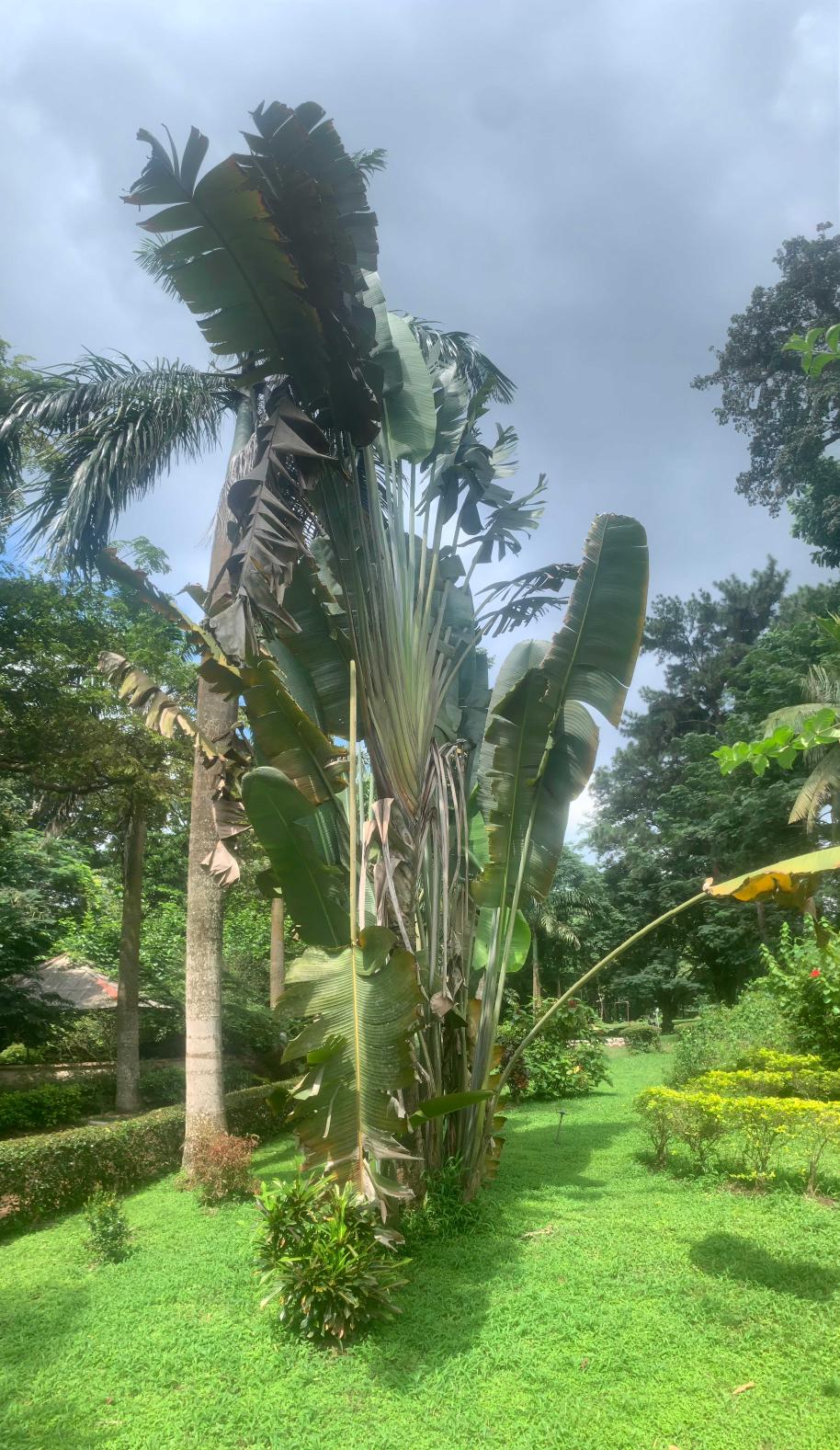
A large, palm-like plant reaching 7–10 m in height, though not a true palm. Leaves are banana-like, up to 3–4 m long, arranged in a single vertical plane, forming a distinctive fan shape. Petioles are stout and sheathing, forming water-holding bases that can store rainwater. Flowers are white, emerging from large, boat-shaped bracts; pollinated mainly by birds and insects. Fruits are woody capsules containing numerous seeds with bright blue arils.
Ecological Information
Prefers full sun to partial shade and well-drained soils. Thrives in tropical climates with high humidity. The leaf bases collect water, which can be a source of drinking water for birds and sometimes travellers—hence the common name. Seeds dispersed mainly by birds.
Uses & Importance
Ornamental: Popular as a focal point in gardens and landscapes for its dramatic, architectural foliage. Cultural: In its native Madagascar, leaves used for thatching, and stems for construction. Practical: Stored rainwater in leaf bases can be tapped in emergencies.
Tree Photos
Quick Info
- Scientific Name
- Ravenala madagascariensis Sonn
- Family
- Apocynaceae
- Tree Code
- UI-BG-TS-030
- Conservation
- Least Concern